
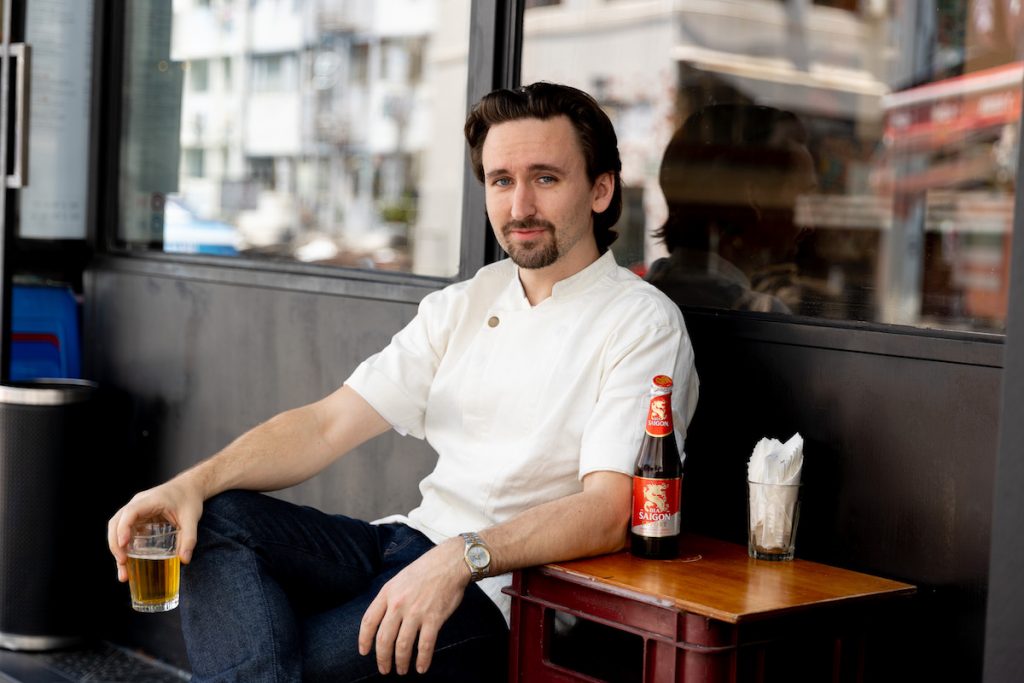
Growing up in the middle of Oklahoma, Logan Hester’s earliest memories of food include tending to his family’s vegetable gardens — a “simple and idyllic” childhood, he says. He had a “hell of a sweet tooth” as a kid; luckily, his mom was an avid baker of custom birthday cakes, and it wasn’t long before he was in the kitchen with her, propping himself up on the counter and helping with the perfectly smooth frosted finish that could only be achieved through his mother’s uncompromising use of American and Italian-style buttercreams.
Deciding to pursue a professional career in food was an easy decision for Logan. After attending culinary school, he staged at Eleven Madison Park, then worked his way up the line in Oklahoma, from country clubs to hotel restaurants. The major turning point in his career came at age 25, when he purchased a one-way ticket to Vietnam. Halfway around the world, he landed on the radar of the acclaimed chef Peter Franklin, who took him under his wing as he prepared to open AnAn Saigon, eventually offering Logan his first head chef position. Unlocking the various dimensions of Vietnamese cuisine in a kitchen unrestricted by conventional boundaries, Logan learned to embrace his creative nature while developing a lifelong passion for the food of Vietnam.
“When cooking for my Vietnamese friends, I would often receive the feedback that my food was ‘different, but delicious,’” he says. Having spent two-thirds of his career cooking in the U.S. and one-third cooking in Vietnam, Logan’s approach to food is rooted in both worlds, but at the centre of it all is the pursuit of novelty and shared human experiences, “crafting a story and experience that brings people closer together”—a philosophy he carries with him in his role as Head Chef at Chôm Chôm. “The new menu we just launched reads more like a love letter to the tables shared and bottles smashed during my time in Vietnam,” he says. Below, Logan reflects back on his country-spanning culinary journey and dishes out his best advice for aspiring chefs.
—
Tell us about your childhood.
I grew up in the outskirts of Oklahoma City (far enough to hear the crickets but not far enough to see many stars). My dad was the industrious type – he balanced three jobs, four kids and still managed to mow the lawn on the weekends. With my mom and my three younger sisters around, there was always a strong female presence in the household.
My childhood was idyllic, wholesome and down-to-earth. I’m really grateful to have grown up there… it let me have a quiet and simple childhood, riding bikes in the grass and tending to vegetable gardens.
What first sparked your interest in cooking?
My mom was a homemaker while I was growing up, focused on taking care of me and my sisters. She would, however, bake and sell beautiful, themed birthday cakes to help cover the expenses of extracurricular activities for us. I remember always watching my mom bake the cakes. When I was tall enough to reach the sink, I would usually get tasked with washing out frosting tips and batter bowls… a pretty great job that allowed me to sneak a spoonful every now and again as “payment”. Interestingly, I would find myself back in the kitchen baking cakes with my mom 10 years later when we opened our own cake shop.
Tell us about your first job in the industry.
Technically, my first job in the industry was foraging and selling blackberries. I learned pretty quick that I could make more money selling them to restaurants instead of door-to-door (especially since I was “foraging” them from the same neighbours’ yards).
My first real job in the industry came when I was 14; it was a summer gig working a hot dog stand at the local minor league baseball stadium (how very American of me). About a month in, the guy I was supposed to cook with didn’t show up, so I ended up running the venue solo for about four hours until someone noticed. The very next week I was working in the suites with the kitchen team.
Did you complete a culinary degree?
I completed two! I went to vocational training at Francis Tuttle Tech for half of high school to study Culinary Arts. Having a couple years of cooking under my belt already, I was able to make it in. I feel the best thing that I learned from that program was how to hold myself professionally in a kitchen. I later graduated from Johnson & Wales University where I had continued studying Culinary Arts.
What was the earliest lesson you learned?
• There is a big difference between what you CAN do and what you SHOULD do.
• Good shoes are more important than cool knives.
• It’s better to ask stupid questions than to make stupid mistakes.
• You have to eat good food to cook good food.
• Don’t strive to be the best, but rather strive to be your best.
Who are some of your mentors, and what did they teach you?
The person that taught me the most would be chef Peter Franklin. He found me through mutual contacts when I arrived in Saigon. He took me under his wing and trusted me with my first chef position. He didn’t just teach me about Vietnamese cuisine, he helped to open my eyes to another level of the industry that I never knew existed. His drive and passion have stayed with me ever since.
What drew you to pursue Vietnamese cooking?
Many people don’t know that Oklahoma has a strong Vietnamese population, so I was exposed to it a lot growing up. I would have pho or banh mi at least once a week! I didn’t realise the role that it would play in my identity until I moved to the East Coast (and gained the nickname “Spicy Chef” for always cooking Vietnamese food for family meal).
When I was 25, I booked a one-way ticket to Vietnam. Originally, I had planned to spend three months cooking throughout Vietnam to learn more about the cuisine’s traditions and techniques, but when I arrived in Ho Chi Minh City, I was approached by Peter Franklin to help him launch what would become AnAn Saigon. It was an opportunity that reshaped both my career, and my love of cooking.
Can you tell us more about how your travels have influenced your culinary journey?
With the last five years cooking in Vietnam, I feel like I could fill half a book with stories. Some of the most insightful experiences I had in Vietnam happened while working with VTV4 as a host for a food show. It had me travelling with a film crew to different off-the-beaten-path destinations and exploring the food culture and agriculture of the area. While the work was exhausting, every time I would finish with a notebook full of new observations and ideas.
My most memorable excursion was to Dong Thap province, where they surprised me at the largest wet market in the area with a challenge to buy everything I would need to make a dinner for four mystery judges showcasing a signature ingredient of the area: the lotus. The catch was I only had a budget of 200,000 VND (about $67 HKD) and a time limit of 30 minutes to shop, then 1 hour to cook (in the middle of the jungle!). It was pure craziness, but that experience, and the others like it were, pound for pound, the most enlightening and formative culinary experiences I have had in my career.
How would you describe your cooking philosophy?
“Good food requires doing good.” “Doing” is perpetual constant action; it’s a constant pursuit to improve and evolve. “Good” is harder to nail down. Most chefs will cite other chefs as the inspiration for their food philosophy, however mine is a German industrial designer named Dieter Rams. His “less, but better” approach to design, along with his ten “GOOD design” principles have helped me to focus my ideas on food and ask myself “is this good?”
What one piece of advice would you give to aspiring chefs?
To quote Anthony Bourdain: “If you’re twenty-two, physically fit, hungry to learn and be better, I urge you to travel — as far and as widely as possible. Sleep on floors if you have to. Find out how other people live and eat and cook. Learn from them — wherever you go.” It took me until I was 25 to do it, but it changed my life.
Looking back, what would you attribute your career success to?
Firstly, succuss is something that is defined differently by everyone. For myself, it’s not about the destination but the pursuit. I find success by continuing to push myself outside my comfort zone and relying on my values to guide me along the adventure. I’m driven forward by the sheer excitement of what tomorrow could bring.
If there was one moment of your career you could revisit, what would it be?
I was on a midnight bus headed form Hanoi to Ha Giang province when we stopped at around 4am to get gas and to stretch. Around 100m away was a single lightbulb by the street that was illuminating a plastic yellow and red sign that simply read “PHO”. Along with the other half dozen patrons on the bus, we hobbled down the road like a heard of the undead. What followed was by far the most beautiful meal of my life!
Inside we found a family operating the shop, doing things a little differently out of sheer necessity. They were simmering their chicken broth over a fire made from a lemon tree that they pulled from their land because it was cheaper than buying charcoal, and steaming their own rice noodles over the chicken broth because it was cheaper than buying pre-made noodles. They had a couple of chickens running around the shop (a few less when we left!). They served the pho with a side of green peppercorns and yellow lemon (because they could sell the black pepper and green limes at the market for more money). It’s the kind of dish that you would have never found inside a big city. It broke every “rule” for Pho Ga, and it was absolutely perfect. I cried over that bowl of noodles. I still taste it in my dreams.
—
Join The Herd for our latest news, weekly perks and exclusives. Sent directly to your inbox.