
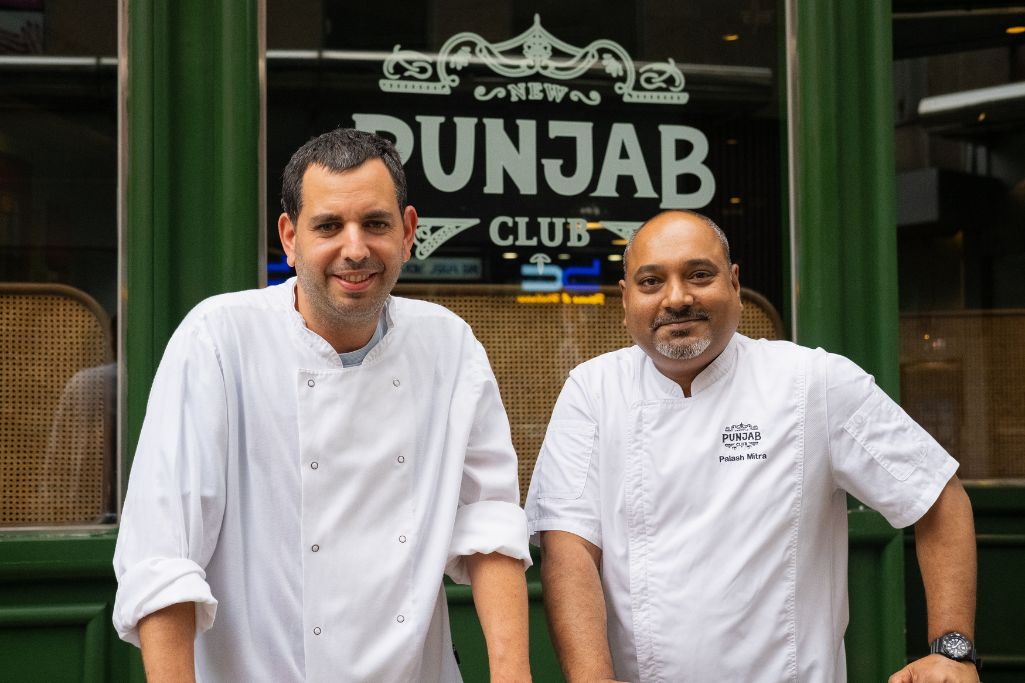
Having first heard of each other through shared connections, Chefs Palash Mitra and Mariano Ramón established a mutual respect for each other’s work. They built a friendship buoyed by their culinary passions via social media. Now for the first time in their five-year connection, these powerhouse chefs, who are each defining the future of this underrepresented cuisine, meet for the first time. As we look towards the weekend’s upcoming chef collaboration at our boisterous tandoor grillhouse, we sit down to discuss their shared love and culinary passion for the cuisines of India, what brought them together and their hope for the future of the culinary art that captured their hearts.
Could you share a little bit about your journey to becoming a chef?
Mariano: I am like everyone in Argentina – I wanted to be a football player! But only a few can achieve that, so very early on, I realised that I needed to find another path. When I finished secondary school, I went to University to become a sports journalist but then realised that University wasn’t for me. I had to find something else.
From very early on, I have always loved to cook. Because my mother worked, I used to cook for all my younger brothers and sisters. I’ve always had this connection to cooking.
Did anyone else in your family history cook professionally?
M: No. No, always just amateur and for the home or the family. So as I looked towards this as an option, I didn’t have the means to attend culinary school. What I did was an apprenticeship with Francis Mallmann, a very famous Argentine chef known for fire-cooking and various Patagonian methods of barbecuing. It was an opportunity to learn the basics of cooking, and it was the first time I started to see what a professional kitchen was. It was something that could actually be a job and one that I could do well.
Ever since, this has been my only job – it is my career. I do not think that in the future, I will ever have another; this is it. I found something I have a passion for, and I’ve discovered something that helps me develop myself.
Did you work with other chefs in Argentina before heading abroad?
M: Yes, after completing my internship, I worked with Chef Narda Lepes, another well-known chef named Latin America’s Best Female Chef, in 2020 by the World’s 50 Best Restaurants. I was a line cook, just starting to work my way through the kitchen.
I liked being a chef because it meant you could do a lot of different things; it also opened the door to travelling, where I could learn about the different food and cultures around the World. At that time, Spain was a big destination for chefs, so I did many stages in Spain, but I also spent some time staging in Peru because of my love for Latin American food.
What was working in Spain like?
M: In Spain, I worked in restaurants that were very modern, or forward-thinking, in their techniques. I wasn’t technically skilful and wasn’t interested in knowing that way of cooking. Yes, it was essential to learn the technical skills to develop my career, but I like restaurants with a bit more of a traditional approach, where I could learn more about the culture and get to know the people from the country. I was a bit more comfortable in that environment.
So what was next? After Peru, after Spain?
M: After Spain, I decided to focus on working in places where I could learn the traditional way of doing things and adapt it in my own way. Rather than doing things someone else’s way; cooking somebody else’s view of the food.
Palash: He didn’t want to accept someone else’s decisions or live somebody else’s life. We all want to live our own lives and do our own things – follow our own ideas as they develop.
M: Yes, yes. And I had a huge love for the markets and the regional foods and how they were used. I used to never think about food in a confined kind of way; I wanted to learn the spirit of something and be able to transform it wherever you are, using what you have there.
It is a bit like when you go foraging in Sai Kung?
P: Yes, even the simplest thing is more pleasurable when you do it with something you’ve selected. When I’m in the forest, and I see something and then pick it up and cook with it, it gives me more satisfaction. I’m using Hong Kong ingredients, but with all of my training and passion for different Indian cuisines and techniques. You feel more connected because you know what the origin is.
So, you learned that this is how you wanted to approach cooking – ingredient and tradition driven – but how did you fall in love with this culinary tradition (Indian cuisines)?
M: At some moment, I knew I was ready to travel East. I wanted to see the world and test myself. At that time, it was challenging for Argentinians to go to the USA, and I don’t have a European background, so I took the opportunity to go to New Zealand via a working holiday experience visa. I had known of Chef Peter Gordon, so a friend and I picked up and travelled there, hoping to find work and experience.
We didn’t speak any English, so we had to learn quickly. I wrote a letter because there was no social media at the time, and went to the door of Peter Gordon’s restaurant asking to work. Working there you have a lot of hints of Asian cuisines – like Thai, Vietnamese and Malaysian.
What was living and working in New Zealand like?
M: It was eye-opening for me to see; it was the first time I had really seen how vast this category of Asian food was. I was living with an Indian family above their restaurant, and it was the first time I saw what Indian food was. Discovering that was a world in itself – it is a food I never really knew until I was 25 years old.
Discovering this kind of food and its culture had a great impact on me.
What was after New Zealand?
M: I wanted to see what the different Asian cuisines were like, so after New Zealand, I made trips around each country working in the kitchens. Thailand, Vietnam, Malaysia, Singapore, Cambodia, and Laos. I wanted to learn about all of these different foods. It was when I was living in the UK with my wife that I knew I was ready to go to India.
At the time, it was more difficult, as there was no social media.
P: There was no keeping in touch or building relationships the way that we did with each other.
M: Yes, and it was hard to explain that I was a Western Chef looking to work in a local kitchen just to understand what they were doing. It was difficult for me to get access.
P: That’s probably like anywhere in Asia. They don’t understand the why. A lot of people who are doing that want to be in your shoes, and you want to do their stuff. They don’t understand.
M: Yes, it was funny. In Bangkok, I sent hundreds of letters, and nobody understood that I wanted to do it.
P: One of the reasons could also be, and wrongly so, that they felt it could be too challenging for you. There is a lot of heritage and family history that goes into the recipes, and sometimes they just think it would be easier to do it themselves than teach you how to do the right things.
M: It was funny because when I went to India, the owner would say, “please teach him everything,” while other chefs, when I would turn around, would put something in, and it would be a completely different colour than what it was before, but I wouldn’t know how they did it. They would say it was a secret recipe.
P: That’s the thing. For a lot of people, it is a family tradition. They don’t go to work or to school, it is a family tradition, and we have to be very secretive about it. There is often the feeling that you have to protect your livelihood, which is why the sharing of knowledge is more difficult. Even for me, in order to get that knowledge, you had to go and live in these small places to obtain the respect and trust of the people there.
This cuisine comes very intuitively, less science and more family recipe and innate…
P: Yes, exactly. That is very true for things like pastry. I’m terrible at pastry because I do not have the aptitude for sticking to rules. For me, there always has to be a boundary that you can explore.
M: Yes, I have the same problem. It is that I cannot stick to a recipe; I want to play around. I just want to change it a little or try something different.
P: The curiosity gets the better of us. What happens if I add something extra?
But obviously for you Chef Mariano, this cuisine resonated enough with you to bring it back to Argentina?
M: It was something of a fixation. Even now, when I’m at home, and I’m reading about India, my wife asks me, ‘why again?’, but there is something that I feel connected to. When you understand something, even if you cannot explain it in words, you get the place. I think this is what happened. Even in other areas of Asia, which I love, I do not have the same connection that I have to India.
India is such an historic place. Sometimes I feel it is underrepresented; Chef Palash and I were speaking the other day at dinner, and the food is so complex and doesn’t have the exposure that it deserves. Sometimes I think that could be because of the presentation or maybe it doesn’t have the market. There are so many flavours and techniques, and they are so diverse, from the breads to the fermentation and the pickles to the marination and the cooking styles. There are so many different varieties of regional cooking across the entire country.
P: This is just my personal opinion, but sometimes when we try to represent Indian cuisine on a larger scale, people try to present it as something else.
There seems to be some way to always mask it when it’s brought outside of India rather than really showcasing what it is. People change it to soothe the narrative, but what we need to do is change the narrative itself.
Both of you are doing a lot of work to showcase this cuisine. What do you hope this weekend’s menu brings to the discussion?
M: You can find different styles of Indian food all around the world. Not only is it incredibly diverse across India, but wherever they travelled, there is some regional touch to the cuisine. In South America, we didn’t have this. We did not have a representation of Indian-Latin American food, unlike Australia, New Zealand, or even the Caribbean…
P: The West Indies, Guyana…
M: Yes. So, what is interesting is that when (in Buenos Aires) we get Indians visiting us, there is a sort of nostalgia for the flavours we are bringing to the table. We use mostly local ingredients, except for the fish sauce, tamarind and coconut milk; everything else is local products and products that are less popular. Our idea is to showcase the diversity of Argentinian products at Gran Dabbang.
I don’t categorise my restaurant. I love India, and we are doing our best to bring together these two things in a way that honours the tradition and heritage of the cuisine where we live and exist. It’s not that we are doing it because we are an Indian restaurant; we are doing it because we are constantly developing our knowledge, and we have found a calling for it.
Why are you excited to work together?
M: I was in Bangkok in 2018, and soon after Chef Palash went to do a pop-up. So I started following him and…
P: I started to follow him as well!
So this is your first time actually meeting?
M & P: Yes! First time meeting.
P: We have been talking for the past five years. But what I’m hoping for from inviting Chef over is showcasing something very Black Sheep. There aren’t a lot of people who want to cook Indian food, but here we have someone who wants to and is so proud of it. He’s doing great and is very successful at it. It is not an easy cuisine to adopt.
I am very proud to have this type of collaboration, and I hope that the guests enjoy it.
M: When I think about New Punjab Club, it is very important that we see the work that is being done here. It is doing work that brings people together, not dividing them. The spirit of this restaurant is bringing something new and dynamic to the conversation.
What are you excited about on the menu? What are the highlights?
P: We had the opportunity to introduce all-new dishes for New Punjab Club, but I think while I love all the dishes, I’m really excited about the Cancha Naan, which is coming out of the tandoor. And then the Pan de Mandioca and seeing how the quail (Tandoori Batair) turns out. He’s also doing the cobia, a signature dish here at New Punjab Club, but in a Gran Dabbang way.
M: In some ways, I’m paying homage to the cobia dish but applying the Gran Dabbang sensibilities to it.
P: It is good; this is how it should be. We learn from each other, and it contributes to the cuisine overall.
—
Join us at our boisterous tandoor grillhouse this weekend as the two powerhouse chefs join hands for the first time. Reserve for lunch here | Reserve for dinner here
Join The Herd for our latest news, weekly perks and exclusives. Sent directly to your inbox.