
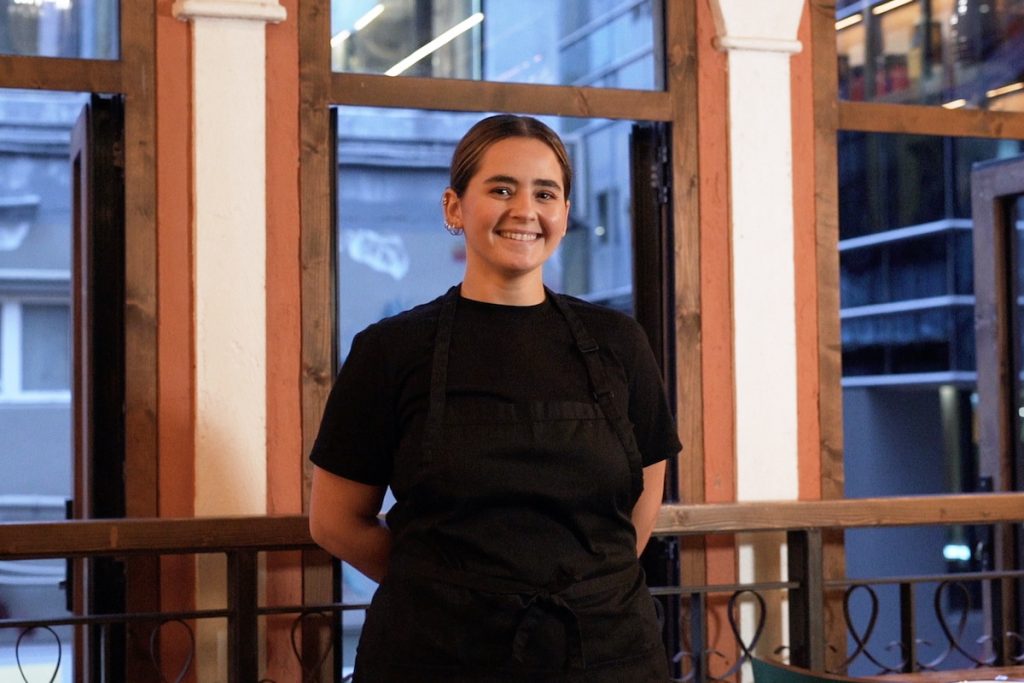
From working in institutions in Lebanon such as Baron and The Lebanese Bakery, to heading up Maison Libanaise in Hong Kong’s SoHo district, Chef Teya Mikhael has proven herself a shining light of the culinary scene. Throughout the bulk of her career, she’s aimed to showcase the richness and diversity of Lebanese cuisine — but that wasn’t always the case. “I tried to move as far as possible from Lebanese cuisine in the beginning. I wanted to see, learn and experience something that I didn’t know, something I hadn’t yet tasted,” she said.
Eventually, the food of her homeland came calling, and she leaned into her affinity with the ingredients and flavours she knew and loved to make a mark in some of Lebanon’s most prestigious restaurants. Working her way up from waitress to commis to sous chef and eventually head chef, Teya expanded her repertoire to the wider sphere of Mediterranean fare, delighting diners with recipes that combined comfort and nostalgia with creativity and innovation. Before moving to Hong Kong, she helmed The Lebanese Bakery in Beirut, where she gained a cult following for her traditional mouajjanet (pastries) and manoushe (flatbread), enlivened with fresh, bountiful toppings.
At Maison Libanaise, Teya’s warm and generous spirit is palpable in every bite, as she draws diners around a table laden with colourful mezze, bold dips and fresh salads, hearth-baked pita breads, and succulent roasted meats. Below, the spirited chef talks about how she got started in the industry, her greatest mentors and her best advice for aspiring chefs.
—
Where did you grow up and what was your childhood like?
I was born and raised in Qobayat, near Beirut. My family, just like most Lebanese families, is huge! Growing up, family gatherings were filled with plentiful food and drink. Those meals were the highlight of our weekly routines. When I got older, I would still travel between the city where I lived, Harissa, and my hometown of Qobayat every week, just so I could gather around a good meal with my family.
What first sparked your interest in cooking?
I studied in Lebanon to get my bachelors degree in Hospitality and Events Management. Towards the end of my studies, I chose to tack on an extra culinary course, and to my surprise, ended up passing it with the highest grade. This is when I really fell in love with cooking and decided that it was something I could do and was worth pursuing. I had always loved cooking, but had avoided it since it wasn’t considered a good or ‘proper’ career for a woman. But the moment I passed my university culinary class with one of the few A+’s awarded, I realised that this is what I wanted to do with my life.
Tell us about your first job in the industry.
My first job was working front-of-house, at the age of 14. It was the summer of 2009 and my cousins used to work in the mountains. I was so excited to learn, to get some experience and to be independent. I decided to join them as a part-time employee for a weekend. My parents didn’t know I was going for a job; they thought it was a sleepover! After I landed the job, it grew from just weekends to whole summers, and eventually to a full-time commitment for six years. I would spend a lot of my free time just trying to learn and draw inspiration from the kitchen team; I just thought it was amazing how talented all of them were.
Did you complete a culinary degree?
I chose not to. Many people in this field jump right away into a kitchen position, and gain practical experience and learning first-hand, rather than going through the route of a formal cooking programme. Once I received my bachelors, I landed my first job in the kitchen as a commis; it was there I learned how to cook consistently and deliver a high-quality product day-in and day-out. I chose this path to lay a foundation for my later career.
What was the earliest lesson you learned?
Only hard work pays off!
Who are some of your mentors, and what did they teach you?
I have been lucky to have many mentors throughout my career: some I met at university, and some I met at work. Dr. Ghassan Beyruti was my university chairperson; he guided me on the right path through university and later on in my career. Chef Patrick Khoueiry gave me my first kitchen opportunity, and passed on all the foundational knowledge that I really needed to get started on my culinary journey.
From 2017 to 2019, I worked under Chef Athanasios Kargatzidis (or Chef Tommy, as we like to call him), the head chef and owner of Baron in Beirut, recently voted as ‘Best Restaurant in Lebanon 2022’ by World’s 50 Best. I learned so much about cooking with seasonality and intuition during this stint, and Chef Tommy taught me how to balance creativity, structure and costs in the kitchen.
Did you always think you wanted to specialising in the food of your homeland?
Not at all! When I first started in this industry, I tried to move as far as possible from Lebanese cuisine. But as I started learning and experimenting, I found myself linking everything back to Lebanese cuisine, and I began to realise just how broad the food of my country was, as I drew familiarities between other dishes from other countries. Lebanese cuisine is truly incredible in its versatility, and at some point I came to the conclusion that this is what I should be doing! My mission became to improve upon the food I already knew, and to share that with others.
What have been some of the biggest influencing factors in your style of cooking?
My style of cooking seems to be a culmination of everything that’s happened throughout my life. It starts with the very roots of where I was born and lived as a child, of memories cooking with my mom and grandmothers, and eventually encompassing every one of the great talents that I’ve worked with in kitchens from Lebanon to Hong Kong. Every person I’ve met has influenced my style of cooking.
Have travels factored largely into your culinary journey?
The best culinary experiences I can remember having were in the UK. Like Hong Kong, London is a true melting pot of cuisines, and an incredible culinary capital. I love how it is not restricted or limited by any rules or conventions. This is how I like to be in my own kitchen — free of restrictions from culinary norms, fixed flavours or cultural boundaries.
How would you describe your cooking philosophy?
It would be staying true to the spirit and ingredients of the cuisine, but also leaving room for creativity, and being able to weave together different regional influences.
What advice would you give to aspiring chefs?
Travel, be curious, work hard. No one will hand you a career on a silver tray, no one will come to you with a promotion or a book of all the information you need to know. Only you can put in the work, do what you need to do and learn what you need to learn. There are never enough ideas you can explore, or number of books you can read. I’ve learned to look for something new to learn and implement each and every day.
Looking back, would you say your career success has been more attributed to skill or luck?
70% skill, 30% luck! Hard work and honing my skills helped open the door for luck. I know that if I hadn’t worked hard, put in the hours, and remained open and curious, I wouldn’t have had the opportunities that I’ve been lucky enough to get.
If there was one moment of your career you could revisit, what would it be?
My first official day working in a kitchen. I would have loved to know back then that I was doing the right thing, and that I would eventually end up in a great place in my career.
—
Join The Herd for our latest news, weekly perks and exclusives. Sent directly to your inbox.